We figured the crossing from the Maldives to Malaysia would take two weeks, give or take. It took eighteen days. Here's what squalls, wet towels, daily dolphins and four good humans taught me about acceptance and how we show up for each other.
Have you ever been certain about how long something was going to take, and then it just... didn't?
I recently signed on as crew on a 40-foot catamaran crossing the Indian Ocean, from the Maldives to Langkawi, Malaysia. Five of us aboard. We talked about it taking fourteen days or less, depending on the wind.
It took eighteen.
That might not sound like a big difference, but trust me, those last days really do wear on you. More on that in a minute.
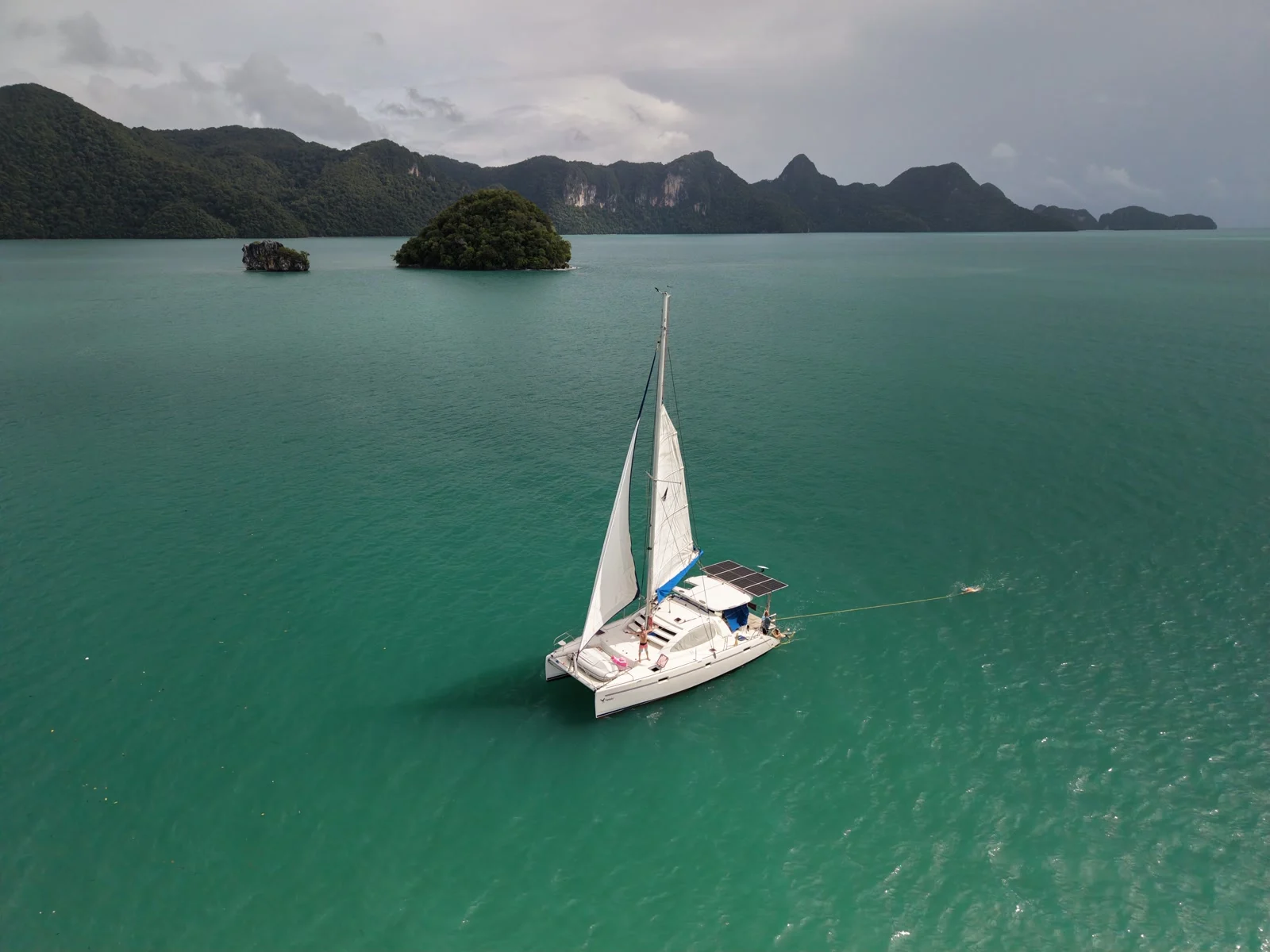
What is it actually like to sail across an ocean?
Beautiful, first of all. We had dolphins on the bow almost every single day, like they were guiding us across. I'll never get tired of that.
And also... wet. Sometimes from the rain, sometimes from water getting in, and sometimes just from sweat with the cabin all closed up. You don't really shower the way you normally would, because of the weather or because you're saving water. If you can take a shower in the rain, great, but then you're wet again. You reuse the same towel, and everything is so humid that it can't dry in your cabin, and it's definitely not drying outside. Your sheets get sweaty and stay that way.
If you're in your cabin trying to rest, you can't open the windows for airflow or the water comes in, and there's no AC. (I'm not trying to sound picky here, just sharing the experience. Trust me, I had a great time.)
You can't really eat whatever you want (although we ate extremely well on this passage, there was plenty of great food), and it's not like you can pop into a grocery store. You can't shower the way you want, go to the bathroom the way you want, work out, or even get much time to yourself.
There are little hazards along the way, too. I sliced my thumb open trying to collect rainwater when the bucket cracked (and we lost the water). I stubbed my toe so badly I had to tape it up, and it was black, blue and swollen for the better part of a week. You get banged up running around a rocking boat in the middle of the ocean. There's no corner store for a Band-Aid. Of course we had first aid kits, but mostly it's a lot of wrapping yourself up with tape and moving on. That old "tape it up" football spirit applies here, I guess.
Being a digital nomad, I'd also planned to work from the boat. I knew Starlink would be available. However, Starlink data on the open ocean is extremely expensive and very limited, so that plan went overboard (pun intended) pretty quickly. Thankfully, I'd done enough prep that my clients weren't affected, but by the end it really did take a toll on me, knowing I had a fair amount of catch-up to do in a pretty short period of time. I needed to get back to my work, and there was no way out of it. I was looking forward to that, and I was also grateful for the experience at the same time. The boat goes as fast as the wind lets it, and there's a big lesson in just accepting the process. I knew the moment I boarded that it was going to take what it was going to take.
It sounds silly, but I also had big plans for video diaries along the way. I could have recorded more than I did. The truth is, a lot of the time you're either tired or tending to something happening on the boat... although that's probably just excuses. Noted for next time. I did record some, and I look forward to sharing more of it on my Instagram.
We're built to look out for number one
As human beings, we're selfish by design. The limbic system, the old part of the brain, is wired for survival. If I don't eat, I die. If I don't reproduce, my lineage ends. That's where a lot of jealousy, lust and envy come from, and the belief system goes something like: I need these resources, I need this quality of life, in order to survive. To be fair, that's true to some extent. If we put ourselves last all the time, we can suffer emotionally, spiritually, mentally or physically, to the most extreme degree.
So when you're underslept, wet, a little grumpy, and hoping somebody else will cover your shift, that part of the brain can get very loud. I have to take care of me.
The cool thing is that we also have the prefrontal cortex, which lets us override that. Executive functioning, reasoning, choosing to act differently than on impulse or our survival mechanism. In recovery we sometimes call this taking opposite action, and it takes practice, awareness, and maturity. None of us are perfect at it, myself included, but it was really highlighted on this trip, and I thought it was so beautiful.
What showing up actually looked like
On that boat I watched four people do the opposite thing, over and over, while every one of them was tired.
Someone would come up as you started your night shift, or as you were switching over, and offer you a coffee... even though they were just finishing theirs, tired, wet and stinky themselves, and probably more tired than you. Everyone took turns cooking, cleaning and washing the dishes. People even asked me, playfully, what I was good at making. I have to admit, my chef skills have greatly reduced over my years of travel, but I'm pretty good at putting together a decent breakfast. Scrambled eggs with some chopped veggies were my go-to, and I could definitely whip up a coffee or two when needed.
We played board games, told stories, laughed, got vulnerable, and supported each other. People took the time to teach each other things around the boat to help us all improve, which was amazing when they didn't have to. And when someone had been short with somebody, they took the time to apologize. Shout out to the captain here (to be fair, I was never bothered by it, I knew he was the least slept of all of us). It was so cute and funny to watch his wife call him out for being short, and then for him to come back and say, "My wife says I was rude to you, and I need to apologize." I love them both for that.
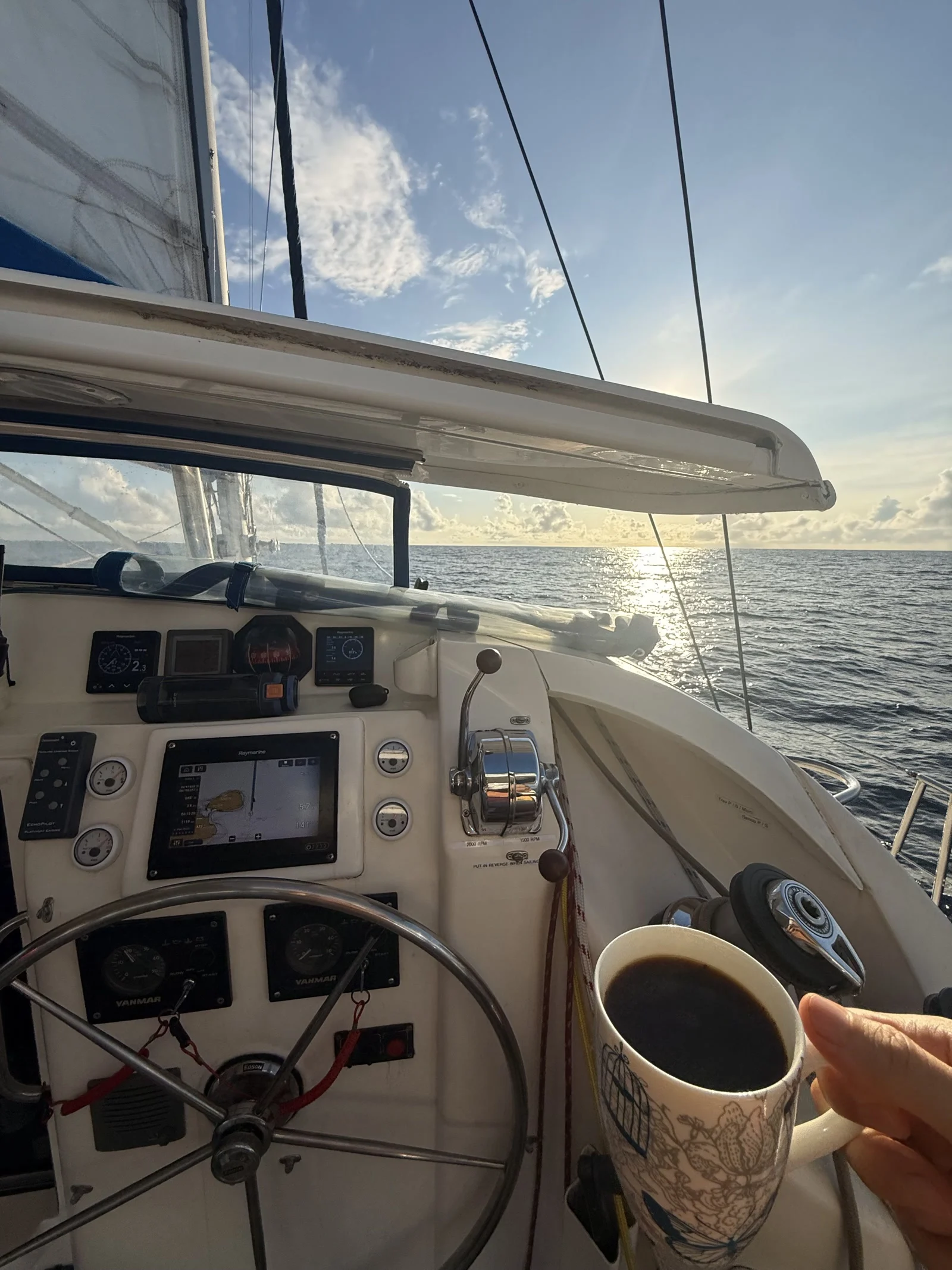
"Good morning, how are you?" "Can I make you a coffee?" "What do you need?" "No, you take the last bit."
Somebody would share their favorite coffee, or their favorite chocolate, because they thought you'd like it. Small stuff, right? It changes the whole way people interact on a boat, and it made for a really incredible experience.
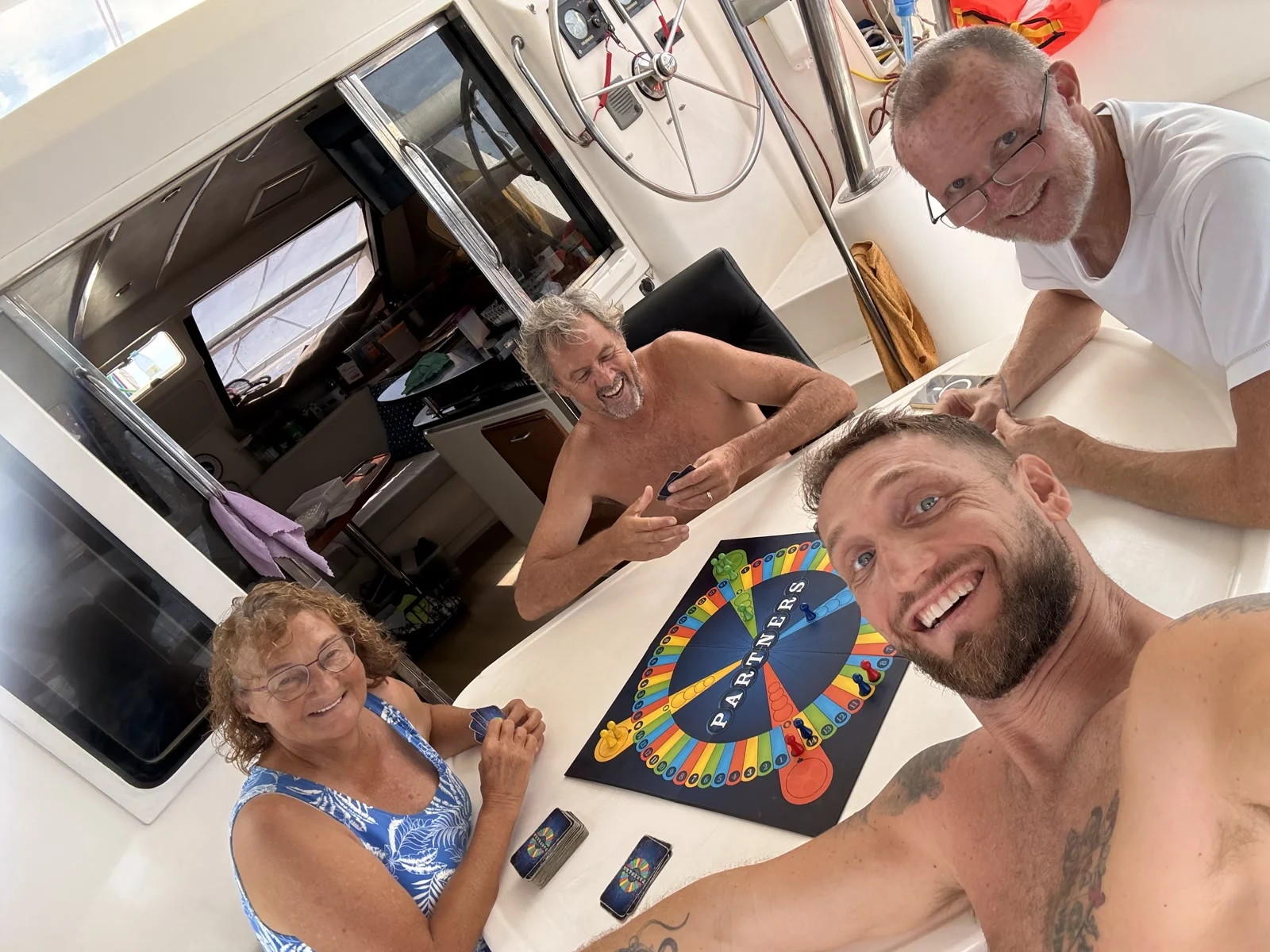
Nico Basson, who owns the boat with his wife Lynette, survived an incredible paragliding accident that doctors didn't think he'd come back from. He spent the crossing grilling for us in the open ocean (some of the best steak, fish and chicken I've had) and teaching all of us to sail, and he did so much of it in the spirit of love, kindness, care and compassion. You could see it in his smile and his perpetual generosity. He just wanted all of us to feel confident, safe and comfortable. He even semi-begrudgingly shared his chocolates, which were his prized possession.
His accident story is truly profound, and worth exploring if you want some real perspective on life. Both his faith and Lynette's faith were incredible. I wrote about them both, and what their partnership taught me about love, over on loveunlocked.com. You can also hear more about his story in his own book, Read Seven and Grow Rich, found on Amazon.
The thing is, these aren't people in recovery. They're just good humans showing up for each other. Which, if you think about it, is what recovery is meant to teach us in the first place: how to live life on life's terms, and to do our best despite the circumstances.
To storm or not to storm?
Shakespeare wrote it in Hamlet: "There is nothing either good or bad, but thinking makes it so."
Picture this. The water is crystal clear, it's sunny, there's hardly any breeze, and the boat is doing maybe 2 knots. Gorgeous, right? Except your brain starts doing math. At this rate it'll take us two or three months. We'll run out of food. We'll burn through all our fuel. So you start praying for wind.
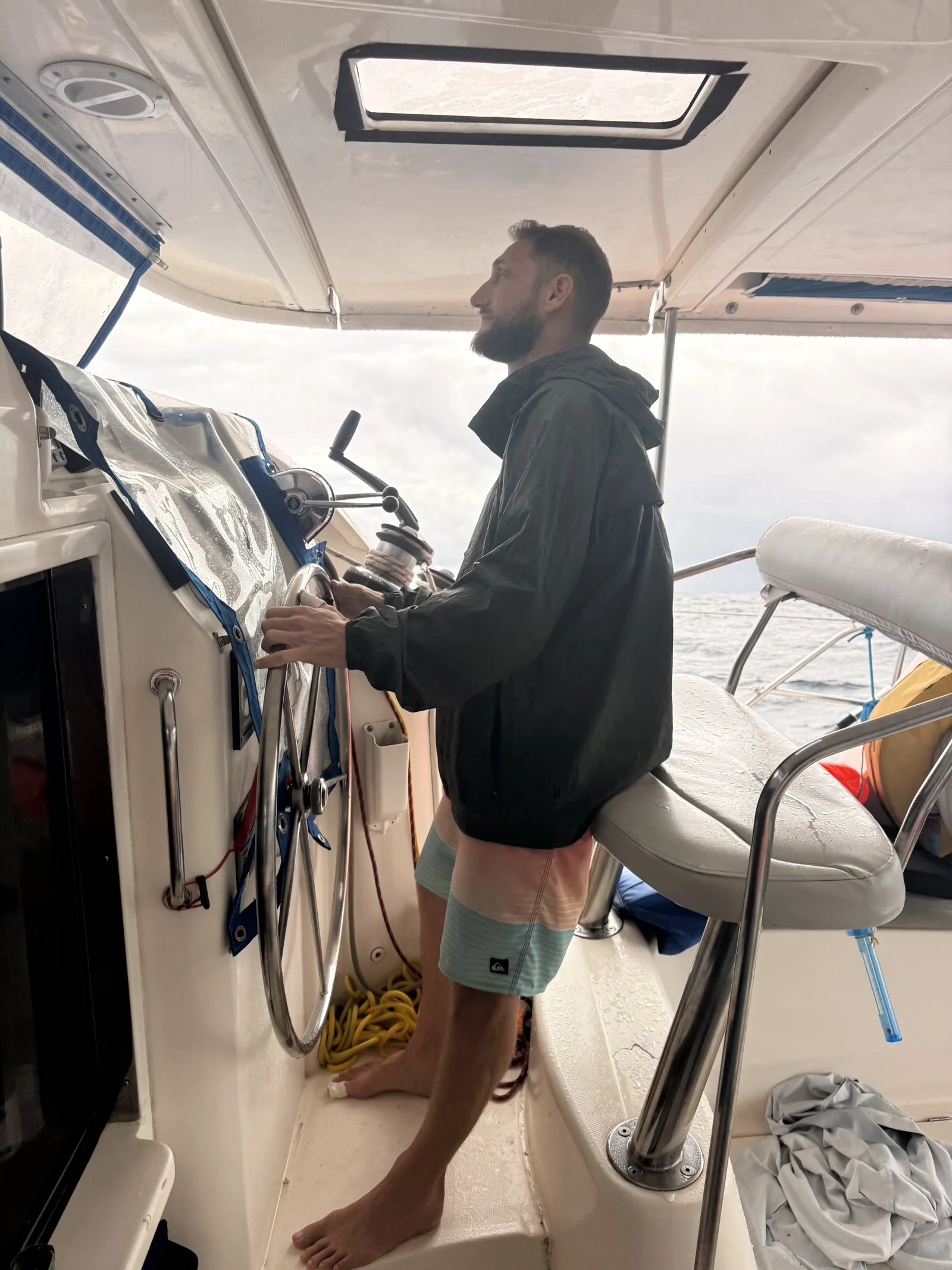
Then the storm comes. The water gets choppy, the wind gets aggressive, it's harder to sleep, and everybody is on duty. More cut fingers, more stubbed toes, rope burns, and some genuinely scary moments where you don't know if the wind and waves will pick up or how long it'll last. The rocking of the boat is incessant, and while I was fine with it, you could tell it could be scary for a lot of people.
But that same wind pushes the boat 6, 7, 8, 9 knots instead of 2. Over a passage that long, that's a massive difference. All of a sudden, every hour, you're covering four or five times the distance you were without the wind.
The rain also gave us fresh drinking water we collected in buckets (well, except for the one I broke), an outdoor shower that saved the boat's limited water supply, and a break from a sun that can really hurt.
The truth is, we need the storms. Without the rain and the wind, we don't move, and we don't survive. Painful sometimes? Sure. But a lot of the time, they're the very thing pushing us forward.
How often does that prove true in life?
How to practice radical acceptance when you're stuck in the middle
Around day seven, eight, nine, I had a realization that's hard to describe. Man, I have more days ahead of me than behind me, and we've already done a lot of days.
Truthfully, that can be mentally taxing. It's a marathon, and thankfully it's one I've trained for through endurance sports and nearly twenty years of recovery. Here are a few things that actually helped me, in the hope that they'll help you too:
- Stop negotiating with the wind. We're not going to sail any faster. It's going to take what it's going to take, and truthfully, we only have so much control over the circumstances. You can adjust the sails, you can try to motor, but at the end of the day we can only control what we can control. Every minute spent fighting that is a minute I'm not living the trip I'm actually on. This rings true for the internet as well (and our desire for connection).
- Shrink the window. Instead of doing a countdown or adopting a "when are we going to get there" attitude (which, truthfully, none of us really did, although the curiosity is always there), think in individual moments. Not eighteen days. This shift. This meal. This conversation. This dolphin encounter. This storm. One day at a time works on the ocean too.
- Do the opposite thing. When I wanted to retreat into "poor me, poor me, pour me a drink" (hello, victim mentality), taking a moment to think of someone else and what they needed was often the cure. On a boat, when everyone's tired, the simplest and kindest offer is usually just asking someone if they'd like a coffee, and that did more for my mood than any amount of complaining.
- Remember why you came (or why you're doing the thing you're doing). I wanted to do a passage. I was praying and asking for it. It had been years since I'd been on a boat like this, so when I got the call, I didn't bat an eyelash. I'd done a few crossings before, but never anything this long. I was excited about it from the beginning, I knew what I was in for, and that was still true on day sixteen, all the way through day eighteen, just like on day one.
It's easy to go full grumpy pants in those moments (back to that "pour me a drink" thing again, right?). We know where that road leads. The reality is, the destination doesn't care how badly we want to get there.
Here's a question to ask yourself: how often do we do this on land, or wherever we are? We decide how long a career change should take, how long it should take to heal, to enter or leave a relationship, to get sober... and then we suffer in the gap between our timeline and reality.
For me, the crossing just made that gap impossible to ignore. I learned a version of this lesson chasing orcas in Mexico too, which I wrote about in the psychology of expectations.
So, what did 18 days at sea teach me?
The same lessons I continue to be taught, truthfully. That acceptance isn't giving up. It's getting honest about where you actually are, and then choosing to make the coffee for someone else anyway.
We're not really meant to do any of this alone. The storms come either way. The people are what make any trip great.
If you're still with me, I leave you with this:
Where in your life are you negotiating with the wind right now, and who could you make a coffee for today?
Much love and safe travels to you always, my friends!
Stuck in the middle of your own crossing?
Whether you're in early sobriety and counting the days, sober curious, or a family member waiting on someone else's timeline, I've been there, and I'd love to help.
Email me directly about custom sober companion or sober retreat options, or about 1:1 Clinical Coaching, or simply start the conversation here. You can also read more about conscious connection at Love Unlocked.