I've freedived with manta rays in Kona, surfed Bali, and logged 350+ dives across 50+ countries without a single drink. Here's what sober adventure travel actually looks like.
Hovering at depth, eight meters down, watching a squadron of manta rays move through the blue all around you, and your entire nervous system turns on in a way no drink or drug could ever touch.
It's a feeling a lot of people are chasing and very few ever get to. I've been sober 19 years and traveled to more than 50 countries, and the question I get more than almost any other is some version of: what do you even do?
As if without alcohol the world goes flat.
So let me actually answer it. Sober travel is most of what my life is built around now, and the sober adventures I've ended up in are bigger than anything I reached for when I was drinking.
What Sober Adventure Travel Looks Like in Practice
Here is the real list.
I've been blessed to dive with sharks around the world, including the Maldives and Hawaii. No cage, no barrier necessary. Just the opportunity to take a single breath and meet an animal eye to eye, on its own terms.
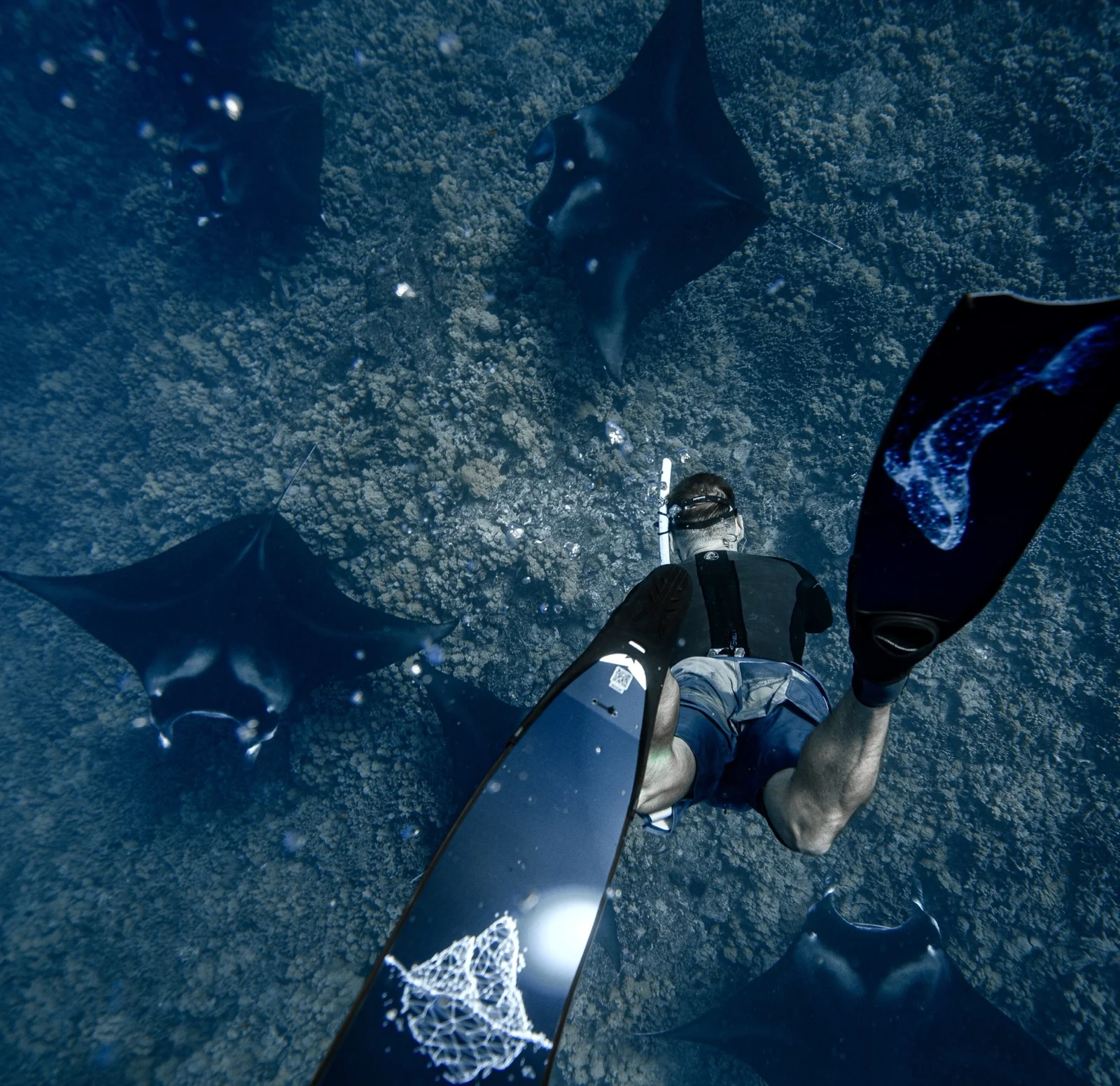
I've swum with humpback whales in Tonga and French Polynesia, and with whale sharks off Isla Mujeres in Mexico. I've freedived with manta rays off Kona on the Big Island of Hawaii, which is the photo at the top of this post, and spent days on friends' boats out there where all kinds of species pass through, pilot whales among them. I've hiked across the lava fields at Kilauea. I've surfed the long, slow lefts at Medewi, on a coast that's near and dear to me, in the place I now call home: Bali, Indonesia.
Over the years I also learned to fly both helicopters and airplanes. I taught my brother to scuba dive down in Cozumel, which is still one of my favorite things I've ever gotten to do. And I've logged more than 350 dives across five continents, every one of them sober.
I want to be clear: this isn't about adrenaline, and I think that part gets missed. Breathwork, meditation, yoga, and long unglamorous stretches on retreat where nothing happens except that you finally sit still with yourself. Those have done as much for me as anything with a shark in it, and honestly they were harder.
This isn't a highlight reel. It's what my life actually looks like, and it's what Nomadic Addictt was built on: the direct experience that sobriety opens doors you were too fogged up to notice.
Why Adventure Works Where Willpower Doesn't
Here's the clinical piece, because it matters.
Alcohol works on the brain's reward system. Specifically, it floods the nucleus accumbens with dopamine, creating that wash of relief, pleasure, and belonging that keeps people coming back. The problem is that over time, the brain compensates. It downregulates its own dopamine production. Normal life starts to feel flat. Only the substance restores the baseline. That's the trap, and the National Institute on Drug Abuse describes that same downshift in plain terms if you want the research behind it.
Willpower tries to fight that system head-on. And willpower is a finite resource. It depletes. It fails under stress, under boredom, under novelty deprivation. Anyone who has tried to stay sober on sheer discipline alone knows how exhausting that is.
Now, here's where I have to be careful, because there's an easy reading of this that's wrong and I see people land on it constantly.
The easy reading is: swap one rush for another. Take away the bottle, bolt on the sharks. Get your hit somewhere the hangover can't find you.
That is not what this is, and if you build your sobriety that way it will hold right up until the day it doesn't.
Why "Adrenaline Junkie" Is the Wrong Frame
I want to name a misconception, because I think it keeps people at a distance from this work.
When people see the diving and the volcanoes, a lot of them assume sobriety turned me into an adrenaline junkie. That I traded one extreme for another because I need the intensity. It's a reasonable guess. It's also backwards.
I'm not chasing these things because a high got taken away and something has to fill the hole. I go because I'm sober enough to want a life worth being awake for. Those two engines can look identical from the outside and they are nothing alike from the inside.
Here is an uncomfortable test I would offer you.
Take any of it away. Pick whichever thing on that list you would miss the most, and imagine it gone. You blow out a knee. The money dries up. You get older, or the season turns, or the trip you had circled on the calendar falls through. Now there's no dive, no wave, no summit. It's just you, in a room, with yourself.
Who is there?
If the adventure was the substitute, you're exactly where you started, except now you have lost the thing that was holding it together, and that's a genuinely dangerous place to be. I have watched people relapse there. Not in a bar. On a couch, injured, six months after the last big trip, wondering why nothing feels like anything.
If the adventure was an expression of a life you had already built, you're fine. Quieter, maybe frustrated, but fine. Because the foundation was never the shark. The foundation was your capacity to sit with yourself without needing to be anywhere else.
Build that first. Everything in this post is what becomes available afterward, not what gets you there.
That's also why I don't sell adventure as treatment. It's a clinical tool I use in my own life and with the people I work with as a sober companion and coach, and it works, but it works on top of a foundation, never in place of one. You can read more about my approach and background at zacspowart.com.
How to Start Sober Adventure Travel
If you're newly sober and wondering where sober adventure travel actually starts, here's what I'd tell you. It's not a plane ticket.
Start with something that requires your full attention. Surfing works because you can't be in your head on a wave. Diving works because the ocean demands respect and presence or it will teach you why both matter. Hiking an active volcano works because the ground beneath you is a reminder that the world is alive and so are you.
You don't need to freedive with sharks on day one. But you do need something with skin in the game. Something that asks something of you. That's where the magic of sober adventures lives, not in the destination, but in what the experience requires you to bring.
Community matters. Identity work matters. The internal rewiring matters. If cravings still run the show, build a real relapse prevention plan alongside the adventure, never instead of it. Hazelden Betty Ford, where I earned my master's in addiction counseling, has solid grounding on that. The way you relate to yourself is the other half of all of this, and it's most of what I write about over at loveunlocked.com.
With that foundation under you, getting your body into genuine aliveness is one of the fastest ways I know to stop missing what you gave up and start building what you came here to find.
Who You Surround Yourself With Changes Everything
So much of early recovery, and honestly most of life, comes down to who you surround yourself with. There's a saying that if you want to know who you are, look at the five people you keep closest to you.
Early sobriety is already a full plate. You're staying sober, getting to meetings, doing the internal work. You're also watching people close to you relapse, which is its own kind of grief, and slowly learning that you can't always tell who is going to still be standing there in a month. Friends are around one day and gone the next. The same goes for the romantic ones.
I'm not saying that to be doom and gloom. I'm saying it because it helps to be prepared, and to be honest with yourself about who is actually around you and what this stage of the work is asking of you.
Now put an ordinary life on top of that. I was working a job, getting to meetings, sitting through DUI classes, and trying to get through school. Finding anything that resembled fun in the middle of all that was its own challenge.
Maybe it was Los Angeles. Maybe it was the particular people around me at the time. Maybe it's just my personality. Whatever it was, I couldn't find people who genuinely wanted to do the things I wanted to do, which was to get outside, get in the water, move, go have some kind of adventure. The few who did were never consistent about it.
Then, at about a year sober, I was blessed with a visit from my cousin.
He flew out to Los Angeles and stayed with me, and for a few days we did all of it. Runs on the beach, splashing around in the waves, sitting in the sun, catching a movie, all the things I had been telling myself I couldn't get to. I told him how much it meant to have him there.
When he was getting ready to leave, he said, "If I were you, I would do this all the time."
I told him I couldn't. I didn't have anyone to do it with.
His reply shaped a new way of thinking that I had no idea would be so profound.
"Then go do it by yourself."
Everything that came after it traces back to that one sentence in Los Angeles: the travel, this site, the book, a sobriety I could actually live inside instead of only survive.
It started small. Going to a movie on my own. Driving out to the beach on my own. Then it became a trip to Mexico, and that one opened my eyes to going deeper. It was my first real taste of sober travel, and it made everything after it feel possible.
Getting in the water was its own turning point. Descending with a clear head, no hangover, nothing left over from the night before, just clean air and open water, something moved. I wasn't escaping anymore. I was arriving.
Then it became another country, and another, and eventually more than 50 countries across six continents.
Here is what I would rather you take from all of this than any of the shark stories.
Pay attention to who you surround yourself with. And don't let other people's limits quietly become your own. If the people around you don't want to go, that doesn't mean you can't go. It might mean you go by yourself, and I know exactly how that lands when being alone is the thing you have spent years avoiding.
Somebody else's limitations do not have to define yours. That's the difference maker. That's the whole thing.
So here is the question I'll leave you with. What is the thing you have been waiting on company to do? And what would it take to go do it this week, by yourself if that's what it takes?
Because that's probably exactly where you need to go.
Interested in 1:1 sober coaching, sober companionship, or custom tailored sober retreats?
Whether you're navigating early sobriety, planning your first sober trip, or looking for someone to walk alongside you, I'm here. Learn more at Nomadic Addictt or start the conversation.
For 1:1 Clinical Coaching, email me directly at zac@loveunlocked.com.